
Nature Inclusive Design -
Offshore Wind
Risks, Realities & Readiness
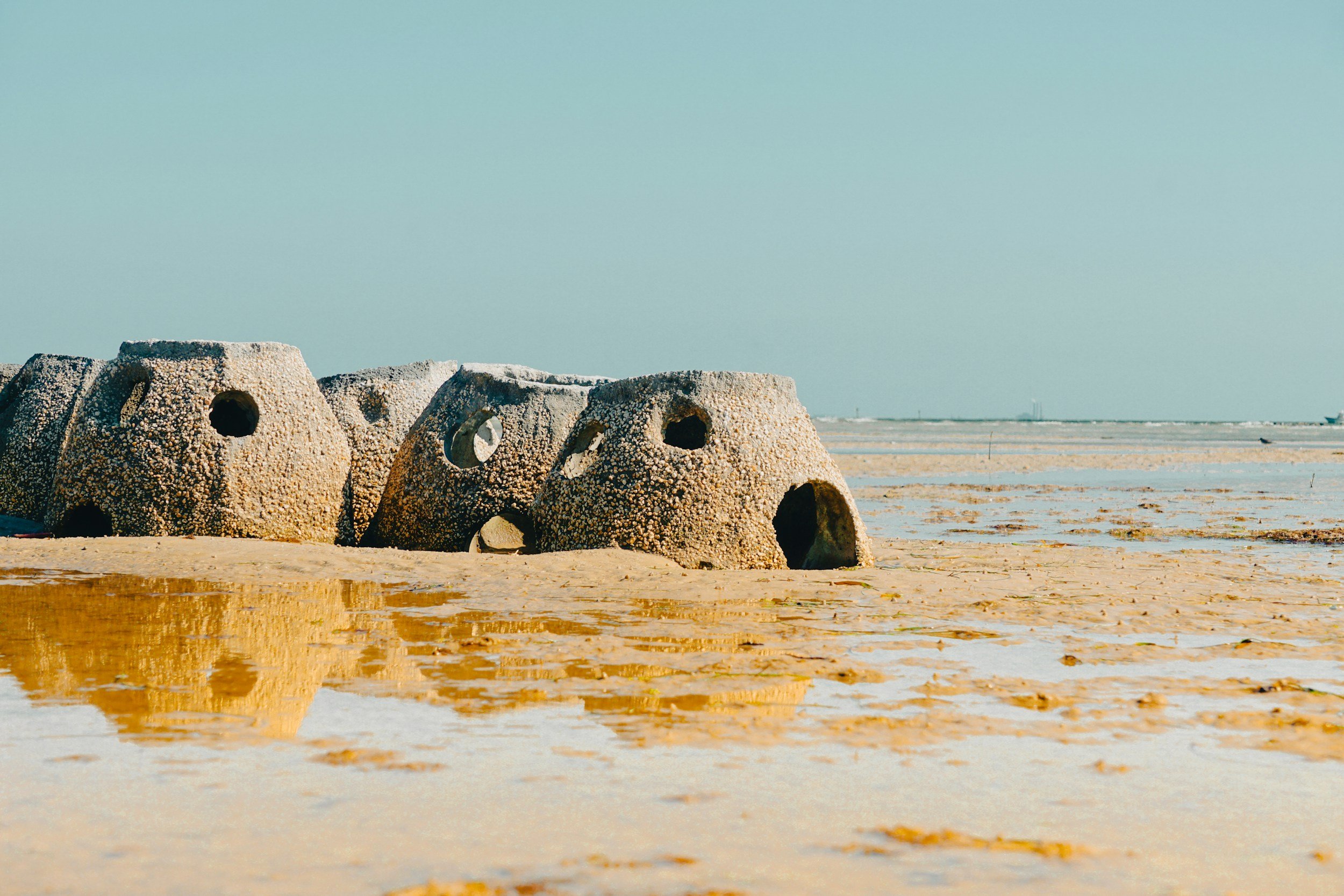
Nature-inclusive design (NID) is increasingly being adopted within offshore wind and subsea infrastructure projects as a means of delivering biodiversity benefits alongside energy generation. As projects scale to meet climate and energy targets, developers are under growing pressure to demonstrate that nature-positive interventions are credible, durable, and defensible over full asset lifetimes.
However, success at pilot scale does not reliably predict ecological performance at scale or over long operational lifetimes. Many early demonstrations rely on short-term indicators such as species richness, abundance, or rapid colonisation, which may reflect aggregation effects rather than genuine ecosystem enhancement. When similar habitat features are repeated across large spatial extents, the cumulative outcome can diverge substantially from site-level observations. In this context, nature-inclusive design is transitioning from a tool for local enhancement to a form of ecosystem shaping, carrying responsibilities and risks that extend well beyond individual projects.
Patch-Scale Complexity and Seascape-Scale Homogenisation
A central challenge in scaling NID is the risk of ecological homogenisation. At the scale of individual structures, increasing surface complexity, cavity provision, or substrate roughness often results in higher local biodiversity metrics. Yet when these same design features are replicated hundreds of times across a wind farm or region, they can reduce variability between sites, eroding beta diversity even as alpha diversity appears high. The resulting seascape may become dominated by a narrow set of habitat types and associated communities, replacing naturally heterogeneous soft-sediment mosaics with functionally uniform artificial substrates.
This paradox highlights an important distinction between structural complexity and ecological heterogeneity. Engineering-led design processes tend to prioritise repeatability, predictability, and robustness, all of which are necessary for construction, logistics, and risk management at scale. Ecological resilience, by contrast, often emerges from spatial variability, disturbance regimes, and uneven resource distribution. Without deliberate design strategies to maintain heterogeneity across scales, the repetition required for engineering efficiency can unintentionally simplify ecological outcomes.
Climate Change as a Destabilising Driver
Climate change further complicates the scaling of nature-inclusive design by undermining assumptions of ecological stability over infrastructure lifetimes of 25–30 years or more. Rising sea temperatures, ocean acidification, altered circulation patterns, and increased frequency of extreme events are already reshaping marine species distributions. In this non-stationary context, ecological baselines established during early project phases may no longer be representative of future conditions.
Designs optimised for present-day target species may therefore become increasingly misaligned with future ecological realities. Species that are currently considered native or desirable may decline, while opportunistic, disturbance-tolerant, or range-expanding species gain competitive advantage. As a result, interventions that appear beneficial in the short term may facilitate long-term shifts toward communities that are less diverse, less functionally complex, or ecologically undesirable at a regional scale.
Invasive and Range-Expanding Species as Design Risks
Artificial and hybrid offshore structures function as persistent hard substrates in environments where such habitat was historically limited. When deployed at scale, these structures form networks of stepping stones that enhance connectivity for hard-substrate-associated organisms. While this connectivity can support some native species, it also presents a well-documented pathway for the spread of non-native and invasive species, particularly under climate-driven range shifts.
Critically, invasive species are often treated as a monitoring concern rather than a primary design risk. Once established on offshore infrastructure, invasive taxa can be extremely difficult or impossible to remove, particularly where access is limited and intervention costs are high. In such cases, adaptive management may serve only to document undesirable outcomes rather than prevent them. This challenges the assumption that monitoring and post-deployment adjustment are sufficient safeguards against ecological failure.
Engineering Robustness and Ecological Selectivity
The requirements of large-scale offshore engineering necessitate standardisation, modularisation, and conservative design margins. These priorities are essential for ensuring structural integrity, safety, and financial viability. However, when nature-inclusive features are subjected to the same logic without ecological constraints, they may inadvertently favour species that thrive under stable, predictable conditions—traits commonly associated with invasive or opportunistic organisms.
The tension between engineering robustness and ecological selectivity is therefore central to the future of scalable NID. Robust structures need not be ecologically permissive to all colonisers, yet current approaches rarely articulate which forms of colonisation constitute success and which represent failure. Without explicit consideration of dominance, competitive exclusion, and long-term community trajectories, biodiversity uplift metrics risk conflating ecological function with surface occupation.
Frameworks, Standards, and Their Limitations
Process-based frameworks such as PAS 1401 represent an important advance by embedding ecological objectives into early design stages and promoting collaboration between engineers and ecologists. These standards help normalise nature-inclusive thinking and improve consistency across projects. However, compliance with such frameworks does not in itself guarantee ecologically appropriate outcomes at scale.
In particular, existing standards provide limited guidance on cumulative effects, seascape connectivity, or invasion thresholds. They tend to emphasise process, monitoring, and iteration, while leaving critical decisions about scale, replication, and acceptable risk largely to practitioner judgement. As offshore infrastructure networks expand, this gap becomes increasingly consequential.
Toward Seascape-Level Responsibility
Scaling nature-inclusive design responsibly requires a shift from site-level optimisation to seascape-level planning. This entails considering how individual projects interact, how connectivity alters species movement and dominance, and how ecological outcomes may evolve under future environmental conditions. It also requires acknowledging that some ecological changes, once initiated, may be irreversible within management-relevant timescales.
Design approaches capable of scaling without generating unintended ecological consequences must therefore plan for uncertainty, selective colonisation, and failure modes, rather than assuming that positive outcomes will emerge through complexity alone. Without such planning, there is a risk that interventions intended to support biodiversity will instead contribute to long-term homogenisation or biological invasion, producing systems that are technically compliant, structurally durable, and financially de-risked, yet ecologically misaligned.
Conclusion
Nature-inclusive design has the potential to play a meaningful role in reducing the ecological footprint of offshore infrastructure. However, as the field moves from isolated pilots to widespread deployment, the criteria for success must expand beyond short-term, site-level indicators. Climate change, invasive species dynamics, and the cumulative effects of repetition introduce risks that cannot be addressed through monitoring alone.
Future frameworks for nature-inclusive offshore design must therefore reconcile the demands of engineering scale with the requirements of ecological resilience, explicitly treating invasives, dominance, and long-term trajectories as design constraints rather than secondary considerations. Only by doing so can scaling deliver durable ecological benefit rather than unintended ecological transformation.